
AI is changing how customers discover, compare, and interact with businesses. Learn how small businesses can adapt to faster expectations, improve customer experiences, and stay competitive without sacrificing personal service.
Read more

AI is changing how customers discover, compare, and interact with businesses. Learn how small businesses can adapt to faster expectations, improve customer experiences, and stay competitive without sacrificing personal service.
Your employees may already be using AI to complete everyday work, but do they know what is allowed? Learn how a practical AI policy can protect customer information, prevent costly mistakes, and help your team use AI confidently without putting your business at risk.
Your small business may not need more leads. The real problem could be slow follow-ups, missed messages, forgotten quotes, and a CRM nobody uses properly. Learn how AI and automation can help you stop losing opportunities you’ve already paid to attract.
AI can help small businesses move faster, but it can also make brands feel fake if it is used carelessly. Learn how to avoid synthetic proof, fake reviews, over-polished content, and generic AI output while keeping real trust at the centre of your business.

Your Google Photos account may hold more business content than you realise. Job site photos, receipts, screenshots, product images, and proof of work often end up in personal accounts, old business accounts, or staff phones. That becomes a business problem when someone leaves or an account gets closed.
AI has changed hiring. Resumes are cleaner, cover letters sound stronger, and interview answers can be rehearsed or generated. Small businesses need to stop trusting polish and start testing proof, judgment, identity, and access risk.
Google Search can now handle more context, but that only helps if you give it the right situation. Learn how to ask better questions before fixing a slow website, changing email providers, buying software, or automating the wrong thing.
The AI ethics conversation can sound dramatic, but for small businesses the practical question is simple: what data are you giving AI, who checks the output, what tools can it access, and what happens if it gets something wrong?
Your AI chatbot may now be the front door to your business. If it gives bad answers, blocks customers from reaching a human, or relies on outdated information, the problem is not just technical. It is a customer experience problem that can cost you trust and sales.
AI can draft, summarise, recommend, and trigger workflows, but it cannot own the outcome. Learn why small businesses need clear human responsibility, approved source material, safe access rules, and review points before giving AI more control.
Many small businesses are using AI, but not much has changed. The owner is still the bottleneck, follow-up is still inconsistent, and the team is still busy. The problem is not AI adoption. The problem is that AI has not been connected to real business outcomes.
AI is not likely to replace whole jobs in your small business overnight. The first work to disappear will be repetitive tasks, drafts, summaries, follow-ups, reporting prep, and admin that quietly eats into your week.
AI should give your business leverage, not become the only way work gets done. Learn how small businesses can prepare for AI outages, protect key outputs, keep human-readable processes, and avoid turning AI into a single point of failure.
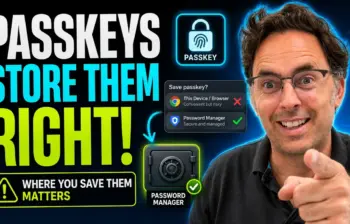
Passkeys can make business logins safer and easier, but only when they are stored and managed properly. Learn why small businesses should avoid saving business passkeys randomly in browsers or devices, and why a proper password manager should come first.

Discover why small businesses need to document key processes, share access safely, and build simple systems so the business can keep running when one key person is unavailable.